
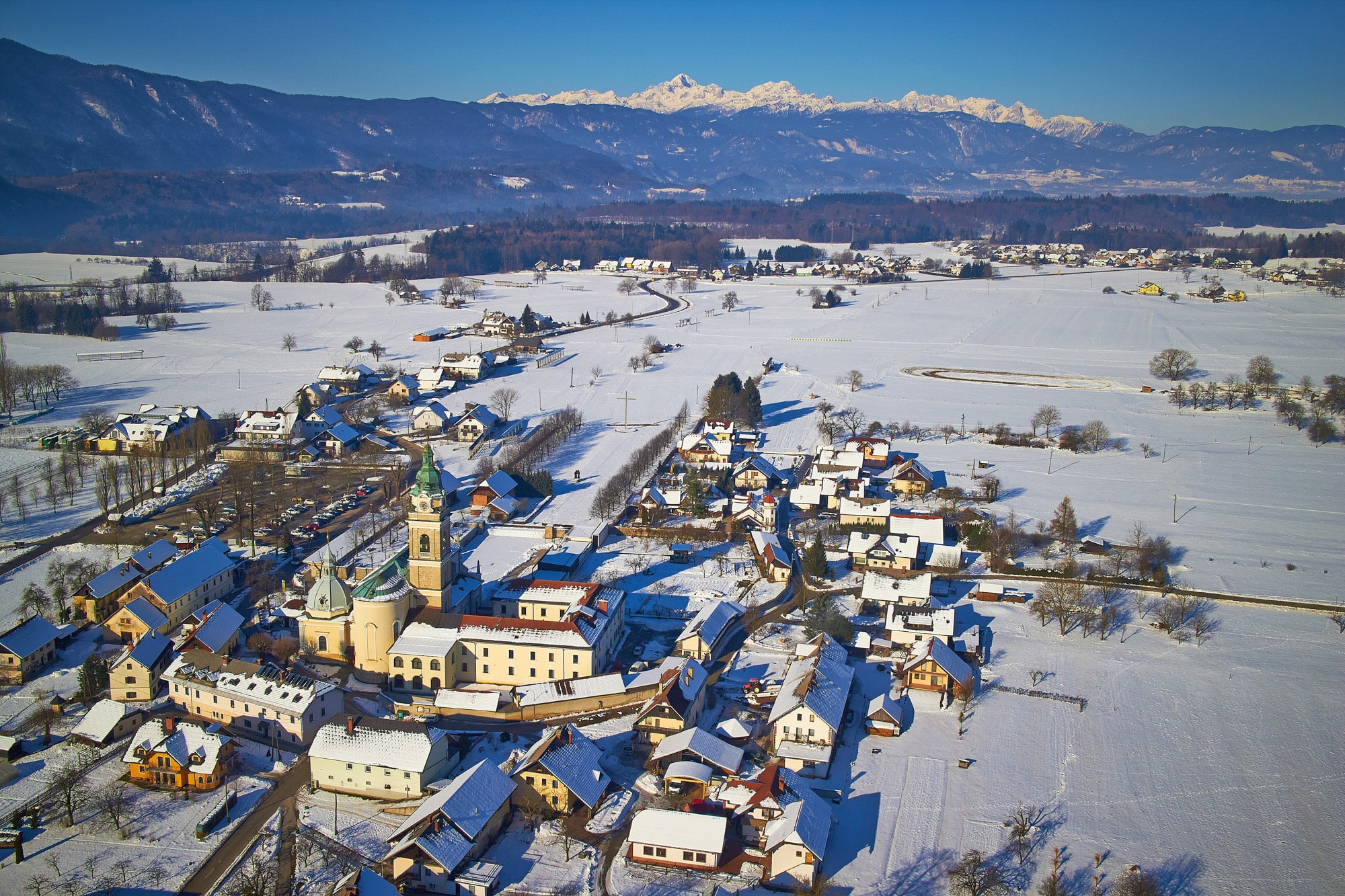
The beautiful shrine of Mary Help of Christians in Brezje has undergone several changes over time. It grew from a small chapel of St. Vitus with an adjoining Marian chapel, into the Slovenian National Shrine of Mary – the Basilica of Mary Help of Christians.
A special honor was bestowed upon the church in Brezje in 1988 when Pope John Paul II awarded it the honorary title of minor basilica. In 1996, during his visit to Slovenia, the Holy Father personally paid homage to Mary Help of Christians in Brezje.
On September 7, 1999, the Slovenian Bishops’ Conference unanimously passed a resolution and declared the Basilica of Mary Help of Christians as the Slovenian National Shrine of Mary. The solemn proclamation took place on January 1, 2000.
Mary Help of Christians of Brezje remains closely connected to the Slovenian people even today; we turn to her in times of suffering and honor her in times of peace.
On the site where the magnificent Marian shrine now stands, there was only a modest chapel dedicated to St. Vitus in the 15th century, a subsidiary of the Mošnja parish.
In additionally to the main altar of St. Vitus, it also had a side chapel dedicated to St. Anthony the Hermit . Leta 1800 pa je dal mošenjski župnik Urban Ažbe postaviti še eno stransko kapelico, posvečeno Mariji Pomočnici. Ljudstvo iz okolice se je v njej rado zbiralo k molitvi.
The number of Mary’s devotees grew significantly when the chapel received the image of »Mary Help of Christians.« Construction began under the guidance of the parish priest Franc Kumer, and the cornerstone of the new building was laid on October 9, 1889.
It was blessed by the Bishop of Ljubljana, Dr. Jakob Missia. The plans for the new building were prepared by architect Robert Mikovitz from Graz, following the instructions of Vicar General J. Flis. The construction was overseen by architect Franc Faleschini.
In 1900, the church was completed. With great solemnity, it was consecrated on October 7, 1900, by Dr. Missia, along with Dr. A. B. Jeglič, then Bishop of Gorizia, and Jakob Trobec, the Slovenian Bishop of St. Cloud in America.
The view of the church, built in the Neo-Renaissance style, gives the observer an impression of grandeur. The building is 39 meters long, 19 meters wide, and 17 meters high.
On the façade, between two semi-circular columns made of red Verona marble that support the main wall, there is an artistically crafted double door. Designed by Janez Vurnik, it was created by local woodcarver Janez Resman from Gorica near Radovljica. On the right wing, from bottom to top, are carved images of prophets who foretold Mary’s birth: Moses, David, and Isaiah. On the left wing are depictions of Mary’s precursors: Sarah, Rachel, and Judith.
The lower panels are adorned with reliefs of angels holding a ribbon inscribed with the names of the figures depicted on their respective wings. Above the main doorway is a marble relief of Mary Help of Christians. To the left of the relief are the angels Raphael and Gabriel, while on the right is a woman lying on a sickbed, accompanied by her family, fervently praying to Mary Help of Christians for healing. It is evident that the artist intended to depict the first miraculous healing (1863).
The area above the façade doors is richly adorned with mosaic decorations, symbols, and inscriptions. Above the relief of Mary Help of Christians is the oval inscription Gate of Heaven, flanked by two oval medallions featuring colorful flowers. Above all of this is a broad band with the motto: Through Mary to Jesus. On the four stone projections are titles from the Litany of Loreto: Virgin of Virgins, Faithful Virgin, Mother of God, and House of Gold.
High on the façade shines a large rose window with eight sections, decorated with white and gold mosaic lilies. The rose window is surrounded by four ornamentations in the shape of lanterns, and on both sides of the rose window are beautifully crafted mosaics of Mary’s monogram. Above the rose window stretches a wide band of gold and blue-red hues. From the niche beneath the tympanum, a richly crafted cross radiates far and wide, while both sides of the niche are adorned with Christ’s monograms.
Above the southern side doors is an artificial window, designed by Professor Vurnik, with mosaic window sides. Above the window is the year 1965, which marks the restoration of the church’s exterior in commemoration of the 30th anniversary of the Eucharistic Congress in Ljubljana. Below the window is a beautiful medallion with the inscription: Mother of Grace.
Slightly lower, in mosaic, are depicted the Slavic apostles St. Cyril and Methodius, the new patrons of the Archdiocese of Ljubljana. In this window, there is also a bust of Mary with the Child, created by the academic sculptor Boris Kalin. This sculpture once stood in the park by the new train station in Otoče, symbolically representing Mary Help of Christians, who, from her high pedestal made of four columns, greeted the incoming and departing pilgrims (1939/1940). It was placed by Father Roman Tominec, and the base of the pillar with the inscription still exists in the park near the Otoče station.
On the 60th anniversary of the coronation of the image of Mary Help of Christians (1967), a chapel dedicated to St. Francis of Assisi was built in the courtyard between the monastery and the church, designed in the style of a Slovenian mountain hut, also according to Vurnik’s plans. The altar painting, created by academic painter Lojze Perko, is framed in bronze, in which the image of Mary Help of Christians was placed in Ljubljana’s cathedral during World War II.
On the eve of the pearl jubilee (September 2, 1967), the altar was consecrated by the Archbishop of Ljubljana, Dr. Jožef Pogačnik. In this way, Brezje gained a new place of worship, where Holy Masses are held, pilgrims receive Holy Communion, and confessions are heard for those who, due to the large crowds, are unable to enter the church.
The mosaics in the church, as well as those in the Franciscan chapel and the courtyard, were created according to the plans of Professor Vurnik by the school sisters in Radovljica, under the professional guidance of the academic ceramist Sister Darinka Bajec.
In the 53-meter high bell tower made of cut stone, there were initially four bronze bells; however, during World War I, three of the larger bells suffered the well-known fate. In 1918, the church received temporary steel bells, which were replaced in 1932 with bronze bells, tuned (by Father Hugolin Sattner) to the melody of Salve Regina. According to many, there is no more beautiful ringing in our homeland than the sound of the bells of Brezje.
During the German occupation (1941 – 1945), there was a danger that the bells of Brezje would meet the same fate as most of their “brothers” across Slovenia. The fact that they remained in place is thanks to the organ master, the late Franc Jenk. He was tasked with removing the bells from the Kranj region, starting with those of Brezje. However, he delayed the task for so long that, by the time the foundations of the “Greater Reich” began to crumble, not even the stolen bells could save it.
Just like the exterior, the interior of the church is also Renaissance in style. Above the large altar made of white marble is a mosaic depicting St. Vitus, who remains the patron of the church. The image is based on a painting by the German artist Matthias Schiestl from Munich.
The main altar and all three side altars are the work of Slovenian artists. Janez Vurnik designed the main altar and the first two side altars. The left one (near the pulpit) is dedicated to St. Anthony of Padua, and the right one to St. Anthony the Hermit. The altar paintings are the work of the painter Ivan Grohar (1867 – 1911). The Sacred Heart altar, set up in 1912, was crafted by Vurnik’s successor Jožef Pavlin from Radovljica; the altarpiece was painted by Ivan Vavpotič (1877 – 1943). Pavlin also sculpted the statues: St. Francis and St. Clare on the main altar, St. John and St. Elizabeth on the altar of St. Anthony of Padua, St. Isidore and St. Agnes on the altar of St. Anthony the Hermit, and St. John Capistrano and St. Paschal on the altar of the Sacred Heart of Jesus.
The center of the shrine is the chapel of Mary Help of Christians. When the new church was being built, the original chapel was left unchanged in its place. To ensure its protection, a second chapel with a dome was built above it. On the wooden altar, alongside the miraculous image of Mary Help of Christians, there were statues of Mary’s parents, St. Joachim and St. Anne, as well as St. Valentine and St. Roch. The builder of this altar is unknown.
The ceiling of the chapel was painted with frescoes by Layer in 1814. Due to the smoke from numerous candles, incense, the intense atmosphere during large crowds of pilgrims, and frequent cleaning, the paintings became completely blurred and could no longer be restored. The altar also began to deteriorate significantly.
Že pred drugo svetovno vojno se je mislilo na obnovo kapelice in oltarja. Prvotni načrt, delo ing. arh. Janka Omahna – je bil že odobren, pa je med vojno izginil. Šele v letu 1954 je po novih načrtih arhitekta Janka Omahna stara kapelica dobila novo lice. Ker je po velikosti prav taka kakor je bila prejšnja, je še vedno prisrčna, domača kakor je bila.
The floor of the chapel is made of exceptionally hard and polished Bosnian granite. The walls are covered with yellowish Istrian marble; at the corners stand gilded statues from the previous altar: St. Joachim and St. Anne, as well as St. Valentine and St. Roch. The ceiling is over a meter higher than the previous one, gilded and perforated to allow ventilation through the space.
The altar, as small as before, is made of white Carrara marble on four small columns. Next to it stand two slender white columns, upon which rest monstrances resembling lamps. In translucent letters, we read on the left side: Mary, Comforter of the Afflicted, and on the right: Mary, Health of the Sick. On the new gilded tabernacle hangs a bunch of grapes with berries made of sparkling rubies, set on a vine. Above the tabernacle is the image of Mary Help of Christians, surrounded by a metal and gilded frame, adorned with various natural stones.
On December 8, 1954, the new altar was consecrated. This is commemorated by a Latin inscription carved into the sturdy altar support: “The beautiful altar was consecrated to the Most Gracious Queen by the Bishop of Ljubljana, Anton Ribičev.” The inscription also includes the year of the consecration.
The church also deserves attention for its Stations of the Cross, colored windows, the work of renowned Tyrolean glassmakers, the pulpit crafted by Pavlin, and the organ. The original Mauracher organ had only 14 registers and was located on a small choir above the door leading to the sacristy, opposite the Marian chapel. This is still remembered by the artistically carved relief on the old choir railing, which depicts the Christmas night with the nativity scene and a choir of angels singing: »Glory to God in the highest, and peace on earth to people of good will.«
In 1911, Dernič from Lancove near Radovljica built a new organ with 32 registers and placed it in the choir above the main entrance. Our greatest organ master, Franc Jenko († June 2, 1968), modernized the organ after World War II, converting it from a mechanical to a pneumatic system and increasing the number of registers to 47.
The pilgrimage church in Brezje is no longer a subsidiary of the Mošnje parish but is directly subordinated to the Archdiocesan Ordinariate in Ljubljana. Since 1898, the administration of the church has been entrusted to the Franciscans, who ensure that the surroundings of the church continue to receive ever more beautiful care.
In the years 1938-1939, the Association of Veterans from World War I, under the leadership of Father Dr. Hadrijan Kokol, redesigned the park in front of the church according to the plans of Jože Plečnik, which were skillfully executed by his student, architect Ing. Valenčič. The church was adapted to fit the newly designed park with matching stalls. The lowered area opposite the main entrance, surrounded by slender poplars, was designated for a magnificent monument, built in the Byzantine style, to honor the Slovenian soldiers who fell in World War I. The outbreak of World War II prevented the completion of this monument.
After the war, in addition to the renovation of the Brezje church, both the interior and the exterior, the surroundings of the shrine were given a more attractive appearance. The elegant access, proximity to the highway, the asphalted area around the church, numerous lamps with mercury vapor bulbs that illuminate the church square and park, and powerful floodlights that illuminate the church and the bell tower are the reasons why the Marian shrine truly appears enchanting at night.
The work was selflessly led primarily by the superiors Father Bogdan Markelj and Father Klemen Šmid. They understood the wish of the Archbishop of Ljubljana, Dr. Jože Pogačnik, who once expressed words full of love and warmth towards Mary Help of Christians: “Brezje must be beautiful!”
(Father Otmar Vostner)
The central ceremony of the proclamation of the Brezje church as a basilica took place on May 27, 1989. It was presided over by the Apostolic Nuncio Giuseppe Montalvo. The Holy Mass was celebrated by the Archbishop and Metropolitan Dr. Alojzij Šuštar.
The document in which His Holiness Pope John Paul II proclaimed the church in Brezje a minor basilica reads:
John Paul II in lasting memory
It is well known to the public that the small church, which once stood within the boundaries of the Archdiocese of Ljubljana, in the village of Brezje, and which was renovated and rebuilt over the centuries, eventually became the central shrine for the veneration of Mary for all of Slovenia.
The faithful of these lands began to devoutly and faithfully venerate the image stored there, which was painted in 1814 by Leopold Layer, as the Blessed Virgin Mary Help of Christians (Mary Help of Christians). In 1900, the then Bishop of Gorizia, the late Jakob Missia, blessed the larger and successfully completed new church, which is truly beautiful and rich in its splendor, built in the style of revived ancient art, and thus also a historical monument of the past, even in today’s time. This, largely thanks to the dedicated clergy entrusted to it, greatly contributes to fostering Christian piety and to the growing fervor of love for the Blessed Virgin Mary.
We sincerely wish that all people in the world may come to know the kindness of the great Mother; therefore, we believe it is important to listen to the requests in which the Archbishop of Ljubljana recently expressed the shared desires of the clergy and the people when he petitioned our Holy See to bestow upon the mentioned church the honorary title of minor basilica (Basilica Minor).
Therefore, we confirm the opinion of the Congregation for Divine Worship, which, based on its authority, has expressed today regarding this matter, and by the fullness of our apostolic power, with this letter, we elevate the mentioned shrine, dedicated to the Blessed Virgin Mary Help of Christians, to the honor of a minor basilica. We grant it all the privileges and rights that are proper to such basilicas. In doing so, the provisions of the Decree on the title of minor basilica, issued on June 6, 1968, must be adhered to.
Given in Rome, at St. Peter’s, under the seal of the Fisherman, on October 5, 1988, in the tenth year of our pontificate.
Augustine Cardinal Casaroli, L.S.
From the Secretariat for Church Public Affairs

With a solemn Holy Mass celebrated by the Archbishop of Ljubljana, Msgr. Stanislav Zore, in the Ljubljana Cathedral of St. Nicholas on Sunday, December 29, 2024, we entered the Holy Year 2025.
The call of the Holy Year is for Christians to deepen their faith and grow in the holiness to which we are called.
Holiness is a gift given to us by Jesus Christ. In the letter of the Apostle Paul to the Ephesians, we read that “Christ loved the Church and gave himself up for her to make her holy.” (Ephesians 5:25-26) Holiness is truly the most beautiful face of the Church: it means rediscovering communion with God, in the fullness of His life and His love.
“This intertwining of hope and patience clearly shows that Christian life is a journey requiring significant moments that nourish and strengthen hope—this indispensable companion that allows us to see the goal: the encounter with the Lord Jesus.” (Hope Does Not Disappoint, 5)
The motto of the Holy Year 2025 is Pilgrims of Hope. “In the heart of every person, hope lives as a desire and expectation of good, even though one does not know what tomorrow will bring. May the Holy Year be an opportunity for everyone to revive hope. The Word of God helps us find reasons for it. Let us be guided by what the Apostle Paul writes to the Christians in Rome.
Hope is born from love and is founded on the love that flows from the heart of Jesus, pierced on the cross: ‘For if, while we were God’s enemies, we were reconciled to him through the death of his Son, how much more, having been reconciled, shall we be saved through his life!’ (Romans 5:10).” (Hope Does Not Disappoint, 1-3)
“The greatest witness of hope is the Mother of God.” (Hope Does Not Disappoint, 24)

The logo of the Holy Year depicts four stylized figures representing people of all colors, nationalities, and cultures from the four corners of the world, resembling the sails of a great shared ship. The figures stand one behind the other, embracing one another, symbolizing the solidarity and fraternity that should unite all peoples.
The first figure represents the Pope, the Peter of our time, leading God’s people toward their shared goal. He clings to the cross, a symbol of faith and also of hope, as the lower part of the cross extends into an anchor. The waves beneath the image are turbulent, signifying that life’s pilgrimage does not always occur on calm waters.
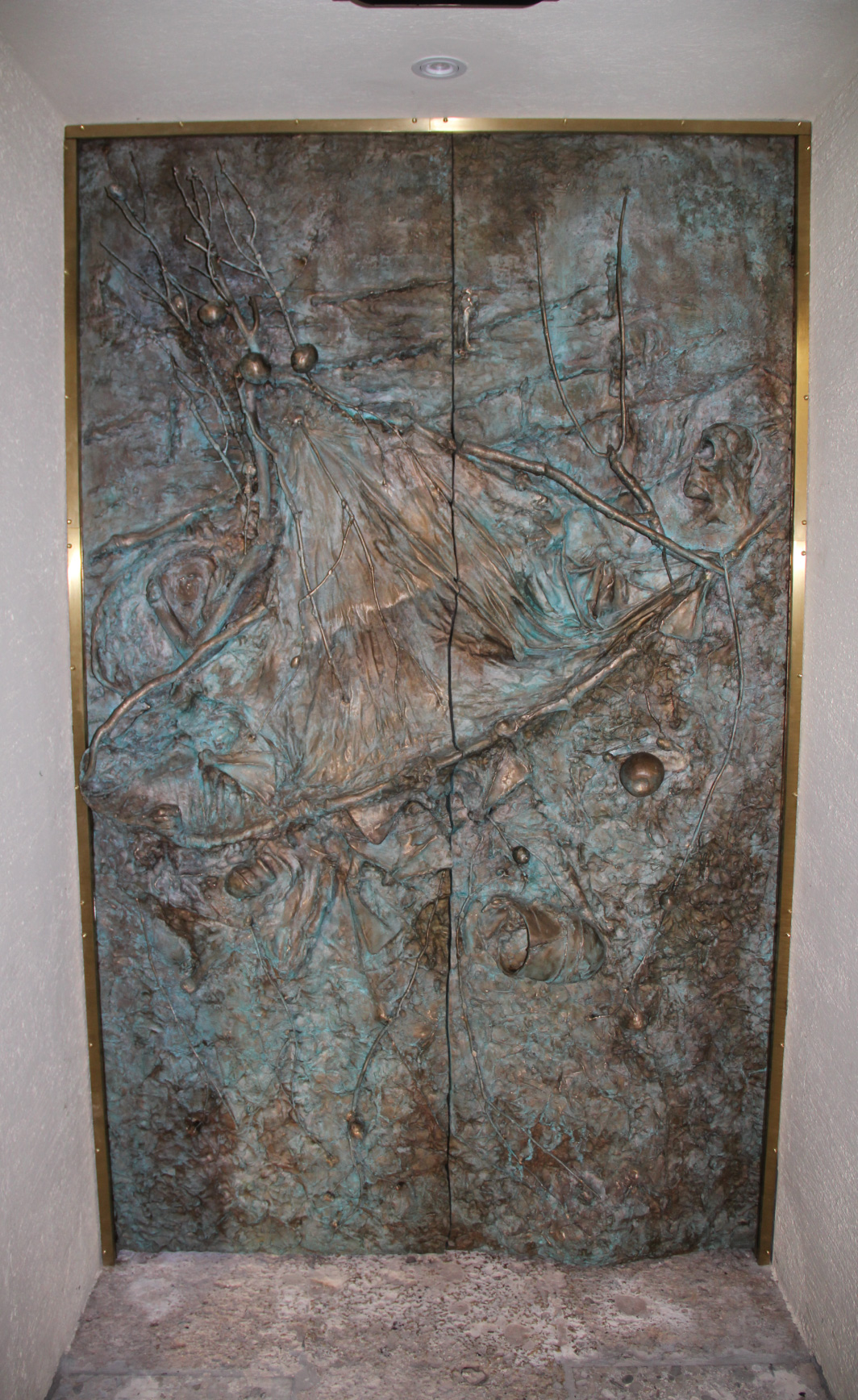
To ensure that this Holy Year becomes a profound experience of grace and hope for the entire Church, I decree that the Holy Doors of St. Peter’s Basilica in the Vatican will open on December 24, 2024, marking the beginning of the Ordinary Holy Year. On December 29, 2024, I will open the Holy Doors of my cathedral, the Basilica of St. John Lateran, which this year will celebrate the 1700th anniversary of its dedication on November 9. In local Churches, the Holy Year will begin on Sunday, December 29, 2024, with the celebration of the Holy Eucharist.
The Holy Doors of the Papal Basilica of St. Mary Major will then be opened on January 1, 2025, the Solemnity of Mary, the Holy Mother of God. Finally, on Sunday, January 5, 2025, the Holy Doors of the Papal Basilica of St. Paul Outside the Walls will be opened. These last three Holy Doors will close on Sunday, December 28, 2025. In local Churches, the Holy Year will also conclude on Sunday, December 28, 2025.
The Ordinary Holy Year will conclude with the closing of the Holy Doors of St. Peter’s Basilica in the Vatican on January 6, 2026, the Solemnity of the Epiphany.
Indulgences are an integral part of the jubilee events. “Reconciliation with God does not exclude the various consequences of sin, which we must be purified of. It is precisely in this area that indulgences find their meaning, expressing ‘the complete gift of divine mercy.’ Through an indulgence, the temporal punishment for sins already forgiven in terms of guilt is remitted for the repentant sinner.” (John Paul II, The Mystery of the Incarnation, 9)
The key to understanding the treasure of indulgences lies in the theological distinction between guilt and punishment. Guilt is forgiven through sacramental reconciliation, while temporal punishment for committed sins generally remains and requires further grace through indulgences. It is only with the Church, in the Church, and through the Church that one can draw from the infinite merits of Christ, the Blessed Virgin Mary, and the saints to attain the remission of punishment for sins, both for oneself and for brothers and sisters on the path of purification toward the perfect beatific vision.
To receive an indulgence, detachment from sin, even venial sin, is necessary, along with completed penance. The fulfillment of this requires three conditions: a good sacramental confession, reception of Holy Communion, and prayer for the intentions of the Holy Father. There are only full and partial indulgences. A full indulgence completely removes all temporal punishment and can be received only once a day, while a partial indulgence removes only part of the punishment and can be received multiple times a day.
To ensure the best experience, we use cookies to store and/or access device information. Consent to these technologies will allow us to process data such as browsing behavior or unique IDs on this website. Refusal or withdrawal of consent may adversely affect certain capabilities and functions.


