
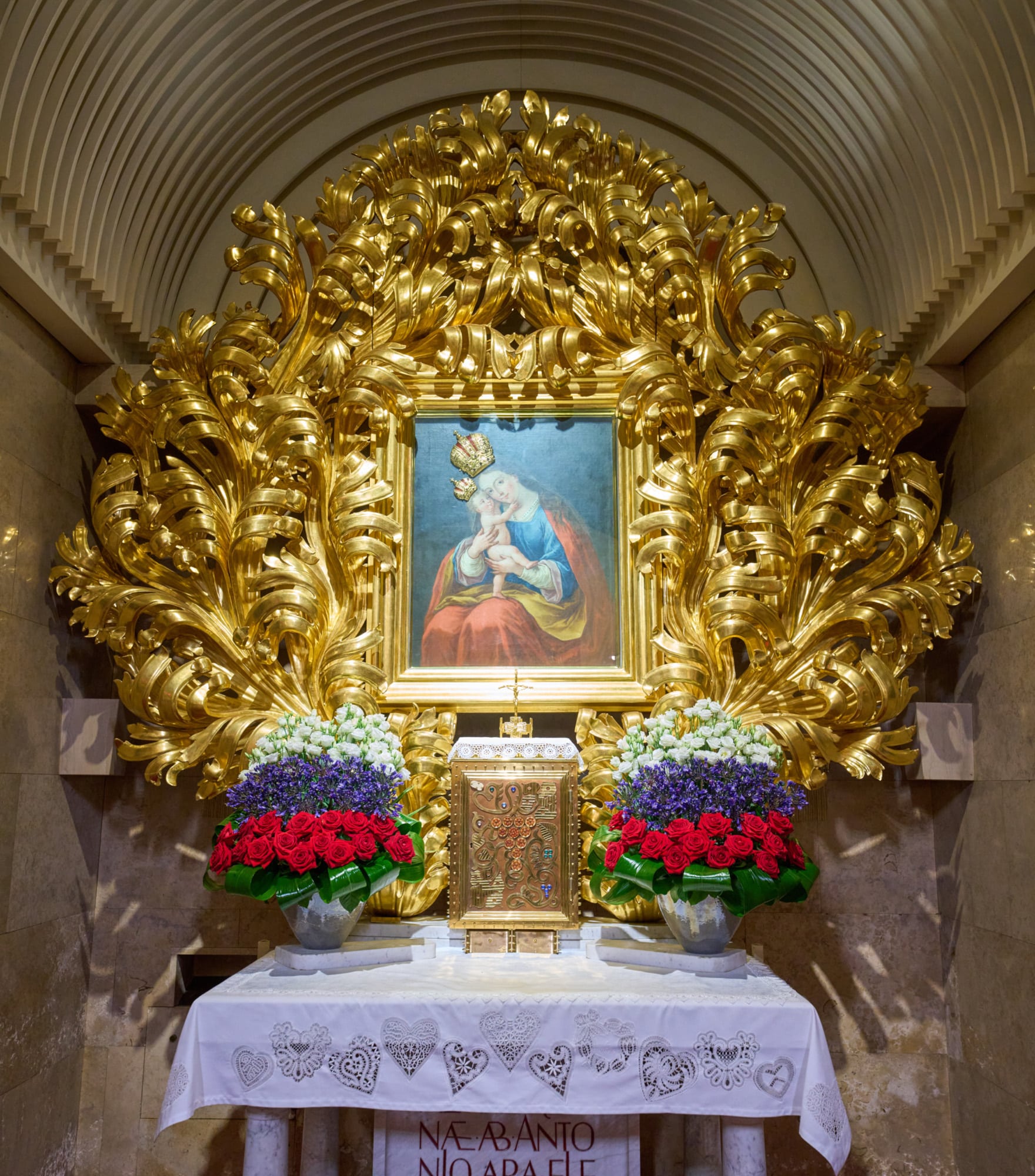
The miraculous image is, alongside the Eucharist, the second heart of the shrine in Brezje. Every pilgrim could share their own story of encountering this image. We have gathered some descriptions here.
The depiction of Mary Help of Christians is indirectly based on the Bible, where the evangelist Matthew reports the flight of the Holy Family from King Herod’s pursuit (Mt 2:13-15). To this biblical account, an old legend adds that, during their flight, Jesus clung to His mother’s neck and asked her: Mother, help!
The painter Lukas Cranach (1472–1553) had this legendary content in mind when he first painted the image of Mary Help of Christians, which is still preserved and venerated in the parish church of St. James in Innsbruck.
Following this pattern, all similar depictions have been created with varying degrees of resemblance; this includes both the original image – painted on the wall – and the current one – painted on canvas – of Mary Help of Christians in Brezje. It is distinctly Slovenian and unique.
The current image was created during the time when Napoleon also occupied the Kranjska region. At that time, the renowned painter Leopold Layer (1752–1828) lived in Kranj.
During the war, the French imprisoned him. In his distress, he turned to Mary Help of Christians in Brezje with trust and promised her that he would paint her chapel and create a new image for the altar if she would deliver him from prison.
Mary rewarded his trust. Layer was freed from prison, and he faithfully fulfilled his promise. In 1814, he repainted the Marian chapel and created the current miraculous image of Mary Help of Christians. The painting is still well preserved today. People say that he painted it while in prison, with iron chains binding his hands.
The Catholic Church has the tradition of crowning images that are venerated by the people. Thus, the great Marian devotee, Bishop Dr. Anton Bonaventura Jeglič, requested permission from Rome for the image of Mary Help of Christians to be crowned as well.
The Holy See granted the request and authorized the petitioner himself to carry out the coronation. On Angelus Sunday, September 1, 1907 , Bishop Dr. A. B. Jeglič, surrounded by over a hundred priests and in the presence of more than 30,000 pilgrims, adorned Mary and the Child Jesus in her arms with golden crowns. The crowns were made by the renowned jeweler Ivan Kregar (1867–1931) in Ljubljana. In memory of this event, Slovenians gather in large numbers around their crowned Queen on Angelus Sunday.
(Father Otmar Vostner)
In the image of Mary Help of Christians in Brezje, many have recognized traces of the circumstances that inspired its creation. The painter’s helplessness in prison is reflected in the small depiction of the Child Jesus, as well as His nakedness, complete dependence, and at the same time, His trust in His Mother.
The Child Jesus presses His little head against Mary, searching for her with His eyes. With His hands, He tries to reach her neck, but His arms are too short, and they only reach her chin. His body is pressed against His Mother, with His left foot standing on tiptoe, while His right foot stretches toward her.
In the image, there is undoubtedly the most beautiful face of Mary, and on that face, her eyes. When Mary looks at Jesus in helplessness and at the same time with deep trust, she surrenders herself completely to Him. However, her eyes do not turn toward Him, but toward us.
Wherever we step in the chapel, Mary’s eyes always follow us… How comforting and joyful is the message expressed in them! Mary’s maternal eye sees us. This is affirmed by the religious truth of Mary’s Assumption: Mary’s eyes are alive and see all our spiritual and physical needs. This is what the painter of the Brezje image of Mary Help of Christians also »conveyed.«
(Father Odilo Hajnšek)
Finally, let us add what the German poet Lenz vom Steyer says about Mary Help of Christians: “In her wonderfully gracious features, one can see dignity and kindness. Full of grace and a miracle of beauty, the Lady looks down on us from the heavenly heights. Mercy is promised by her friendly gaze, and joyful, heartfelt happiness, as if assuring us of her intercession in the name of Jesus.”

Mary also pilgrimages. Not only does she invite us to herself, but she also goes with us. Wherever we Slovenians have moved around the world, the image of Mary Help of Christians has gone with us. She is present in the »corners of God« in our homes and in various shrines around the world.
Already in the 1920s, the Slovene Brezje began to emerge in Lemont, near Chicago. The image of Mary Help of Christians also resides in Washington, Colorado, and Wisconsin, in Canada (Toronto), in Argentina (Buenos Aires, Luján), in Chile (Santiago), in Australia (Melbourne), in England (London), in Germany (Munich), in France (Habsterdick), in the Netherlands (Heerlen), and in Austria (Vienna), to name just some of the largest shrines with Her image.
In the book Mary Help of Christians in Brezje, it is written: “Yet we can say that She always travels, especially in the hearts of Slovene emigrants and expatriates. Before leaving their homes and homeland, they would, if possible, go to Mary in Brezje to say farewell. They were aware that they needed her protection on their journey abroad.
The first generation of emigrants prayed to Mary in Brezje: “Come to us, Mary, for what will we do alone, orphans, in the cold foreign land!”
One of the most precious relics that Slovenians took with them around the world was the image of Mary Help of Christians from Brezje. In humble conditions, they built altars in her honor in refugee camps. Later, when they found a new home and work, they also built magnificent shrines. With the image of Mary, their new homes became even more familiar. In prominent churches, they managed to set up altars or at least ensure a faithful replica of Mary from Brezje.” (Mary Help of Christians in Brezje, Družina, 1997)
The farthest that Mary Help of Christians has traveled was into space, where she was taken by the astronaut of Slovenian descent, Dr. Jerry M. Linenger. When asked why he brought the Slovenian flag and the image of Mary Help of Christians from Brezje with him into space, he responded: »I was certainly happy to have the image of Mary Help of Christians because it gave me a sense of security. My roots go back to Slovenia, my grandparents are from here, so this place is special to me. I wanted to take it with me because of those roots and also for the people in Slovenia, so they could be proud to know that they were indirectly with me in space.«
We kindly ask you to share your experience with your image of Mary Help of Christians. Tell us if your church, the altar in your church, a chapel, or a sign is dedicated to Mary Help of Christians. We would be happy if you let us know that Mary Help of Christians holds a special place in your home. We would be delighted to receive a photograph and description. We hope that through this growing collection, the awareness of Mary Help of Christians’ presence among us will be strengthened.
For Mary Help of Christians does not only inspire and accompany Slovenians, others also accept Her loving gaze and gladly commend themselves to Her. May God’s smile, which Mary Help of Christians from Brezje so convincingly reveals, accompany you on all your journeys!

Leopold Layer painted the image of Mary Help of Christians in Brezje based on Cranach’s depiction of Mary in Innsbruck. However, his image is quite independent and distinctly Slovenian. He dressed Mary in 18th-century attire. Above all, the faces of Jesus and Mary in Layer’s depiction received new features.
Mary in this image is a happy, loving mother who eloquently expresses the great love with which she bends toward Her Son, and with which the Son trustfully and lovingly embraces Her. At the same time, the image beautifully depicts Mary’s kind affection towards the devotees to whom She is turned. It is understandable that this loving Mother inspires so much trust that God rewards it with extraordinary graces.
The Catholic Church has the tradition of crowning images that are especially venerated by the people. Since extraordinary graces were granted at Brezje, the thought of crowning the image of Mary Help of Christians became increasingly alive. The desire was initiated by the Franciscans, the guardians of the miraculous image, and the great Marian devotee, Bishop Dr. Anton Bonaventura Jeglič, requested the necessary permission from Rome.
The Holy See granted the request and authorized the petitioner himself to carry out the coronation. For this solemnity, they chose Angelus Sunday, September 1, 1907 .
Already on the eve, a large number of people gathered, and entire crowds continued to arrive in Brezje on Sunday morning by train, wagon, bicycle, and on foot. Early in the church, Masses began and followed one after another, the confessionals were crowded, and thousands received Holy Communion.
At nine o’clock, over 30,000 faithful gathered in Brezje, drawn by their love for Mother Mary. Bishop Jeglič, surrounded by more than a hundred priests, adorned Mary and the Child Jesus in her arms with golden crowns. The crowns were made by the renowned jeweler Ivan Kregar in Ljubljana. Since then, Angelus Sunday has been a special feast for Brezje.
Mary Help of Christians in Brezje became increasingly linked to the fate of our people. The faithful venerated her with heartfelt devotion in their moments of joy, and in times of bitter suffering, they turned to the Mother with childlike trust. During World War I, large crowds gathered in special assemblies, repeatedly asking Mary Help of Christians for peace in the world.
On the Feast of the Assumption in 1915, over 10,000 faithful gathered in Brezje. Many went to confession and received communion, and the Holy Sacrifice united them in prayer for peace and for their homeland. The following year, there was a gathering of Marian societies from the Gorenjska region in Brezje. About 6,000 members prayed to Mary Help of Christians to protect their parishes and all those living in them from the harsh blows of war. In 1921, around 10,000 men and boys gathered at Mary’s shrine to renew and strengthen their faith and lives according to her teachings.
The image of Mary is uniquely connected to the II Eucharistic Congress for Yugoslavia, which took place in Ljubljana from June 28 to 30, 1935, under the protection of Mary Help of Christians. With the permission of Bishop Rožman, the image was brought to Ljubljana on June 28, framed in a special frame designed by architect Ogrin.
During the journey, Mary was greeted by 13 parishes from Gorenjska, and people stood along the road everywhere, praying and singing. In Ljubljana, more than 100,000 faithful, under Mary’s protection, consecrated themselves to the Eucharistic Lord.
After the congress concluded, on June 30, Mary was solemnly returned to Brezje amidst many greetings. The following day, the Pope’s delegate to the Eucharistic Congress, Polish Cardinal Augustyn Hlond, along with the Apostolic Nuncio in Belgrade, all the local bishops, and many foreign bishops, visited Brezje. They returned their visit to Mary Help of Christians and thanked her for the successful congress.
During the hardships of World War II, Mary Help of Christians shared the suffering of her children in the capital of Slovenia, Ljubljana.
On April 23, 1941, the Germans expelled the Franciscans from the Marian Shrine in Brezje and prohibited the celebration of divine services in the church.
Brother Jozafat Finžgar, the only one allowed to remain in Brezje, secretly brought the image of Mary Help of Christians to Ljubljana five days later, disguised as a carpenter’s assistant with the image in his backpack. From Šiška, where the refugee stayed for a few hours, he went to the Franciscan monastery on Prešeren Square.
To ensure the safety of the miraculous image, it was transferred to Trsat, accompanied by the necessary documents verifying the authenticity of the image. There it remained hidden for two years, until it was returned to Ljubljana on May 19, 1943. On May 29, more than 25,000 faithful made a pilgrimage to Rakovnik with the image. Before Mary, they vowed to protect themselves, especially from those sins that provoke God’s punishment.
The image of Mary Help of Christians then found its resting place in Ljubljana Cathedral, on the altar of St. Dizma. The following day, on May 30, the entire Archdiocese of Ljubljana solemnly consecrated itself to the Immaculate Heart of Mary before the image. The cathedral became a new pilgrimage site—another Brezje.
Day by day, people came to Mary Help of Christians in times of distress and fear, seeking help and comfort. When the long-lasting storm of war finally subsided, the exiles began to return to their homes.
On June 15, 1947, Mary Help of Christians was finally able to return home to her shrine in Brezje. Many pilgrims were eagerly awaiting her return in Brezje. With what joy she was received when she was carried through the church to the great altar by the Franciscan provincial Father Teodor Tavčar and Dr. Kimovec!
After the solemn Mass of the bishop, she was placed in her old spot in the chapel, and a hymn of thanksgiving was sung. Brezje once again received its treasure, and once more, hundreds of thousands of pilgrims began coming to the Mother.
(written by Father Dr. Metod Benedik OFMCap)
The beginning of the depiction of Mary Help of Christians is indirectly based on the Bible, where the evangelist Matthew reports the flight of the Holy Family from King Herod’s pursuit (2:13-15). To this factual biblical account, an old legend adds that during the flight, Jesus clung to His mother’s neck and asked her: Mother, help!
The painter Lukas Cranach (1472–1553) had this legendary content in mind when he first painted the image of Mary Help of Christians, which is still preserved and venerated in the parish church of St. James in Innsbruck. Following this model, all similar depictions have been created with varying degrees of resemblance, including both the original image—painted on the wall—and the current one—painted on canvas—of Mary Help of Christians in Brezje. This image is entirely Slovenian and unique.
The current image was created at the time when Napoleon also occupied the Kranjska region. At that time, the famous painter Leopold Layer (1752–1828) lived in Kranj. During the war, the French imprisoned him. In his distress, he turned to Mary Help of Christians in Brezje with trust and promised that he would paint her chapel and create a new image for her altar if she would deliver him from prison.
Mary rewarded his trust. Layer was freed from prison, and he faithfully fulfilled his promise. In 1814, he repainted the Marian chapel and created the current miraculous image of Mary Help of Christians. The painting is still well preserved today. People say that he painted it while in prison, with iron chains binding his hands.
The Catholic Church has the tradition of crowning images that are especially venerated by the people. Thus, the great Marian devotee, Bishop Dr. Anton Bonaventura Jeglič, requested permission from Rome for the image of Mary Help of Christians to be crowned. The Holy See granted the request and authorized the petitioner himself to carry out the coronation.
On Angelus Sunday, September 1, 1907 , Bishop Dr. A. B. Jeglič, surrounded by over a hundred priests and in the presence of more than 30,000 pilgrims, adorned Mary and the Child Jesus in her arms with golden crowns. The crowns were made by the renowned jeweler Ivan Kregar (1867–1931) in Ljubljana. In memory of this event, Slovenians gather in large numbers around their crowned Queen on Angelus Sunday.
The image of Mary is also connected to the history of the II Eucharistic Congress for Yugoslavia, which took place in Ljubljana from June 28 to 30, 1935, under the protection of Mary Help of Christians. With the permission of Bishop Dr. Gregorij Rožman, the image was brought to Ljubljana on June 28 in a special frame, designed by architect Ogrin, with great solemnity.
Immediately after the conclusion of the Eucharistic Congress, on June 30, the image was solemnly returned to Brezje. (This journey was described by Father Roman Tominec in Cvetje in 1935.)
The following day, on July 1, the Pope’s delegate, Cardinal Augustyn Hlond, arrived in Brezje with the Apostolic Nuncio in Belgrade, along with all the local and many foreign bishops and dignitaries. He returned his visit to Mary Help of Christians and expressed gratitude for the successful congress.
In the history of the miraculous image, it is also worth mentioning the World Congress of Organized Catholic Women, which took place in Rome from April 7 to 15, 1939. The participants from various nations presented Pope Pius XII with the image of Mary that their people venerated the most. The representatives of Slovenian Catholic girls presented the Pope with the image of Mary Help of Christians. The image, created according to the design of academic painter B. Remec and crocheted by the skilled teacher Pelhanova, was particularly cherished by Pope Pius XII, who placed it in the most prominent position among all the images.
During the hardship of World War II, Mary Help of Christians shared the suffering of her children in the heart of Slovenia, in Ljubljana. On April 23, 1941, the Gestapo expelled the guardians of the Marian shrine in Brezje and prohibited the celebration of divine services in the church.
Five days later, on April 28, the brave friar Jozafat Finžgar, the only one allowed to remain in Brezje, secretly brought the image of Mary Help of Christians to Ljubljana in his backpack, disguised as a carpenter’s assistant. From Šiška, where the refugee Mary Help of Christians stayed for a few hours, he made his way to the Franciscan monastery on Mary’s Square. To ensure its safety, the image was then transferred to Trsat.
With all the documents verifying the authenticity of the miraculous image, it was accompanied by Father Bernardin Mlakar and the controller Vladimir Tominec for protection. There, the image of Mary Help of Christians remained hidden and unvenerated for two full years, abandoned, just as her people were abandoned.
On May 19, 1943, the image of Mary Help of Christians returned to Ljubljana, to the great joy of all. Accompanied by a crowd of 25,000 people, it was taken on a penitential procession to Rakovnik on May 29. Before Mary, the gathered people promised to especially avoid those sins that provoke divine punishment.
Her gracious image took its refuge in the cathedral on the altar of St. Dismas, precisely where it had its throne for three days eight years earlier, when it was carried in a solemn procession from Brezje to the Eucharistic Congress. The following day, on Sunday, May 30, the Ljubljana diocese solemnly consecrated itself to the Immaculate Heart of Mary before the image of Mary Help of Christians in the cathedral.
Pressed by the horrors and hardships of war, the people fervently implored Mary with the Pope’s words to have mercy on us. The cathedral became a place of pilgrimage – another Brezje. Day by day, hour by hour, they came to Mary Help of Christians in their distress and fear, seeking help and consolation. Here, the song continually echoed (from Velike Lašče):
“Mary, help us in this time of war,
each of us looks to you evermore.
Mary, all the people cry out in plea:
Mary, come and help us, we pray to thee!”
The four-year raging storm of war finally fell silent; the exiles began returning to their homes. For Mary Help of Christians, too, the time had come to return to her home of grace and mercy.
On June 15, 1947, the great bell of the Ljubljana Cathedral announced that Mary Help of Christians was returning home. Many pilgrims had been waiting at Brezje since the early hours for her return. When the Ljubljana Franciscan Provincial, Fr. Teodor Tavčar, and Dr. Kimovec stepped out of the vehicle carrying the image of Mary Help of Christians and brought it through the church to the main altar, the entire crowd burst into tears of joy.
After the solemn bishop’s Mass, the image was carried into the chapel, and a hymn of thanksgiving was sung. Pilgrims continued for a long time, sliding on their knees around the altar and gathering around Mary Help of Christians, like children around a mother who has returned from a long and difficult journey. Brezje once again received its treasure, and hundreds of thousands of pilgrims regained the open fountain of grace and goodness of their Mary Help of Christians.
Who could count all the religious celebrations and devotions that have taken place under the patronage of Mary Help of Christians! Yet some must not be overlooked: the Golden Jubilee of the Crowned Queen of Slovenians in 1957 also fell on September 1, just as the coronation had 50 years earlier.
Pilgrims began arriving on Saturday—on foot, by regular trains, as well as on carts and bicycles—staying awake through the night in the presence of their Mother. There were over 20,000 pilgrims in total. In addition to the local bishop Vovk, the church celebration was attended by the Archbishop of Zagreb, Dr. Franjo Šeper, the Bishop of Banja Luka, Dr. Dragutin Čelik, the Greek Catholic Bishop of Križevci, Dr. Gabriel Bukatko, and the Bishop of Maribor, Dr. Maksimilijan Držečnik. The jubilee celebration demonstrated how Slovenians continue to love and honor Mary to this day.
In memory of the most magnificent religious manifestation ever held on Slovenian soil—the Eucharistic Congress in Ljubljana in 1935—a celebration of its 30th anniversary took place on Angel Sunday, September 5, 1965. A small Eucharistic congress was held. What Ljubljana had been 30 years earlier, Brezje became on this day. The nighttime Eucharistic procession with candles along a kilometer-long path was truly heartfelt and moving for all who participated, as well as for those observing. The nighttime procession was followed by nocturnal adoration and a midnight Mass.
Glavno evharistično službo božjo za jubilejno proslavo je ob 9. uri v imenu odsotnega nadškofa opravil stolni prošt dr. Stanko Lenič. Sončni žarki, ki so prijetno greli gorenjsko ravnino med Triglavom in Stolom, so lepo simbolizirali evharistično sonce – Kristusa, ki nas s svojo navzočnostjo v presveti razsvetljuje, ogreva in nam krepi duše na romarski poti proti nebeški domovini.
The Pearl Jubilee of the coronation of the Brezje Mary on Angel Sunday, September 3, 1967, was particularly solemn. More than 25,000 pilgrims attended. Among those present at the Pearl Jubilee were a few individuals who, as children, had attended the coronation 60 years earlier (Fr. Metod Valjavec, Fr. Bogdan Markelj, Mr. Rok Knafelj, and others).
The solemn Masses were celebrated at intervals by three Slovenian ordinaries. A special significance to this celebration was given by the historic event that, during the main jubilee Mass, the Archbishop of Ljubljana, Dr. Jožef Pogačnik, for the first time prayed the Canon with the words of consecration in Slovenian , in the living national language—just as Saints Cyril and Methodius had consecrated 1100 years earlier.
In 1969, devotions and church celebrations at Brezje were dedicated primarily to the sick. On April 23, Archbishop Dr. Jožef Pogačnik celebrated Holy Mass, concelebrated by seven golden jubilarian priests, for the sick of the Kranj deanery. He addressed them and gave them his blessing.
On August 19, the administration of Ognjišče organized a pilgrimage for the sick to Brezje. The devotion was led by the Bishop of Slovene Littoral, Dr. Janez Jenko, who celebrated Mass, preached, and blessed the sick.
On September 28, the pilgrimage devotion for the sick of the Radovljica deanery was led by Prelate Dr. Vilko Fajdiga, who also individually blessed the sick. Each time, more than a hundred sick and elderly individuals were present. For those who were more seriously ill, car owners provided free transportation. All these devotions were successful and touched the hearts of the sick and others deeply.
Let us conclude with the words of the German poet Lenz vom Steyer: »In her wonderfully gentle features, one sees dignity and grace. Full of grace and a miracle of beauty, the Lady looks down upon us as if from the heights of heaven. Her kind gaze promises mercy and joyful happiness of the heart, as if assuring us of answered prayers in the name of Jesus.«
(recorded by Fr. Otmar Vostner)
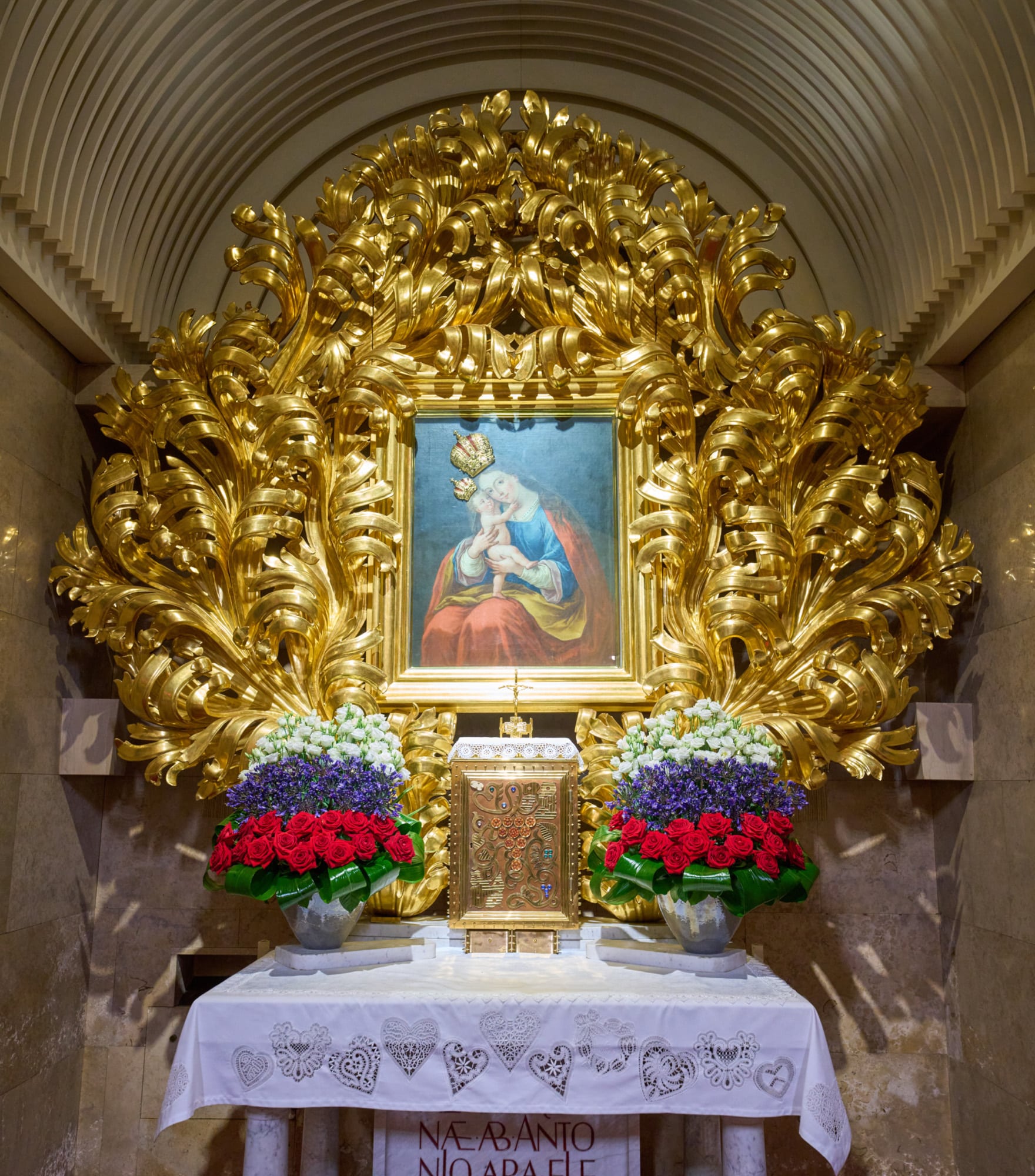
Mary Help of Christians is our patroness, to whom we entrust ourselves in our prayers. She is the Mother of our faith, as we also call her.
September 7 (Kimavec): The 107th Anniversary of the Coronation
September 8 (Kimavec): The Nativity of Mary and the Pilgrimage of Grandparents
September 13 (Kimavec): Day of Prayer for Vocations
September 21 (Kimavec): Pilgrimage of Soldiers – Day of the Military Vicariate
October 5 (Vinotok): Anniversary of the Consecration of the Church and the 26th Anniversary of the Declaration of the Basilica of Mary Help of Christians
December 8 (Gruden): 60th Anniversary of the Consecration of Mary’s Altar
December 28 (Gruden): Prayer for Life
To ensure the best experience, we use cookies to store and/or access device information. Consent to these technologies will allow us to process data such as browsing behavior or unique IDs on this website. Refusal or withdrawal of consent may adversely affect certain capabilities and functions.


